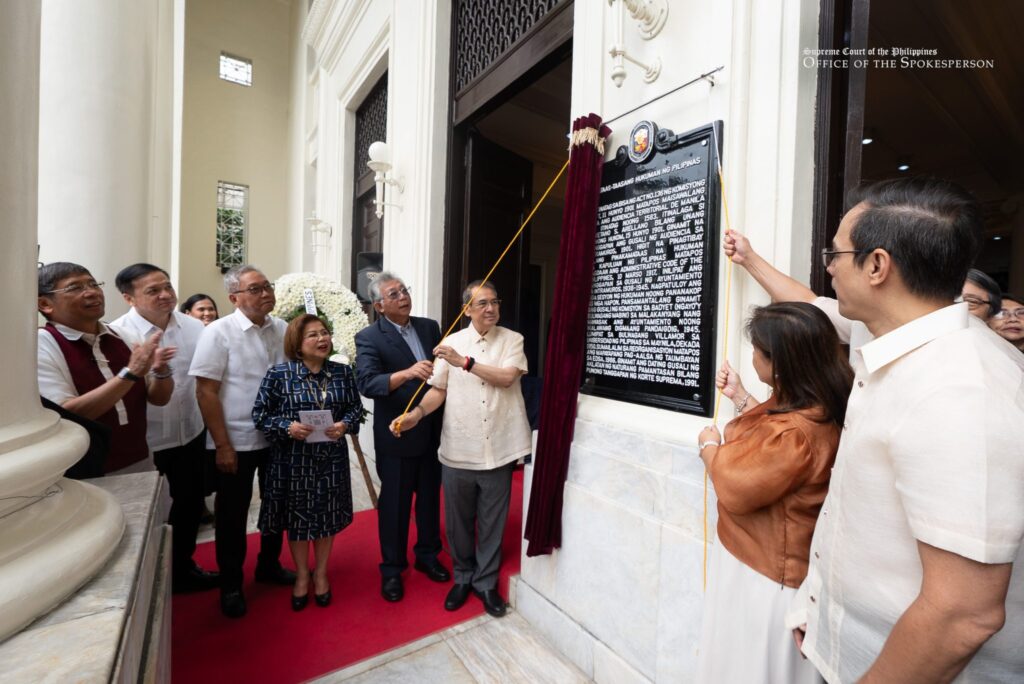
MANILA, Philippines — The Supreme Court of the Philippines officially unveiled a historical marker from the National Historical Commission of the Philippines (NHCP) on June 5, 2026, at the Supreme Court New Building in Padre Faura, Manila, as part of the celebration of the Court’s 125th Anniversary.
The unveiling ceremony was led by Chief Justice Alexander G. Gesmundo together with Associate Justices Alfredo Benjamin S. Caguioa, Amy C. Lazaro-Javier, Rodil V. Zalameda, Jose Midas P. Marquez, and Raul B. Villanueva.
Also present during the event were Manila Mayor Francisco ‘Isko Moreno’ Domagoso, NHCP Commissioners Lisa Guerrero Nakpil, Maria Eloisa P. De Castro, and Francis M. Navarro, as well as University of the Philippines Manila Chancellor Dr. Michael L. Tee.
The NHCP grants historical markers to sites, institutions, structures, individuals, and events with significant historical and cultural value. The installation of the marker officially recognizes the Supreme Court New Building as an Important Cultural Property, safeguarding it from exportation, modification, or demolition.
Originally constructed between 1928 and 1930 as the main library of the University of the Philippines, the building was designed by renowned Filipino architect Antonio Toledo in the neoclassical tradition. Following the transfer of UP to Diliman in 1949, the structure became home to the Department of Foreign Affairs until it was renovated and formally designated as the new seat of the Supreme Court in 1991.
The historical marker chronicles the evolution of the Supreme Court since its formal establishment through Act No. 136 on June 11, 1901, under the leadership of the first Chief Justice, Cayetano Arellano. The Court’s early sessions were held at the Audiencia building in Intramuros before relocating to the Ayuntamiento building in 1938. Following the destruction of the Ayuntamiento during World War II, the Court temporarily transferred to the Budget Commission building, now known as Mabini Hall, in Malacañang.
In succeeding decades, the Court occupied Villamor Hall at UP Manila, now referred to as the Supreme Court Old Building, which currently houses the Office of the Court Administrator and the Judiciary Memorabilia Hall. Adjacent to it is the Centennial Building, completed in 2002 and designed by Palafox Associates, which accommodates several key support offices of the Court.
Speaking on behalf of the Court, Justice Raul B. Villanueva emphasized that the historical marker symbolizes the enduring role of the judiciary in Philippine democracy.
“The marker serves as a constant reminder that the Court is not merely a majestic building, but a continuity of principle that has outlasted regimes, wars, and even the destruction of the very buildings where it once sat,” Justice Villanueva said.
He further underscored the Supreme Court’s role in safeguarding democracy, protecting constitutional rights, and ensuring the rule of law.
“Every landmark decision, doctrine, and legal precedent handed down from this Court has woven itself into the very fabric of the Republic, giving citizens the assurance that justice prevails over might,” he added.
Supreme Court Spokesperson Atty. Camille Sue Mae L. Ting likewise reflected on the institution’s resilience through generations of justices and reforms.
“Through the years, the Supreme Court has faced both progress and challenge—from war and occupation to periods that tested its independence. Yet, it endured,” Atty. Ting stated.
She also highlighted the Court’s continuing reforms under the Strategic Plan for Judicial Innovations 2022–2027 (SPJI), aimed at improving efficiency, accessibility, and innovation in the justice system for all Filipinos.
“These markers are more than reminders of our past. They remind us of the responsibility we carry today and the legacy we leave for tomorrow,” she said.
NHCP Executive Director Carminda R. Arevalo, in her message, emphasized the enduring trust of the Filipino people in the Supreme Court throughout its 125-year history.
“Sa loob ng 125 taon, nanatiling matibay ang tiwala at paggalang ng mga Pilipino sa Korte Suprema bilang pangunahing tagapagtaguyod ng Saligang Batas at taga-pangalaga ng katarungan,” Arevalo said.
During the ceremony, the Certificate of Transfer and Acceptance of the Historical Marker was formally signed by Supreme Court Clerk of Court En Banc Atty. Marife M. Lomibao-Cuevas and NHCP Executive Director Arevalo, witnessed by Atty. Ting and NHCP Deputy Executive Director for Programs and Projects Alvin R. Alcid.
Chief Justice Gesmundo and the Associate Justices also unveiled the Supreme Court 125th Anniversary commemorative plaque, which designates the Supreme Court New Building as the Court’s principal seat from 1991 to the present and honors the Chief Justices and current members of the Supreme Court En Banc who have served there.
The unveiling ceremony forms part of the year-long celebration of the Supreme Court’s 125th Anniversary under the theme, “SC: 125 Years of Tradition and Innovation,” highlighting the Court’s commitment to preserving the rich history and heritage of the Philippine Judiciary while continuing to advance judicial reforms and public service.( SC Office of the Spokesperson)