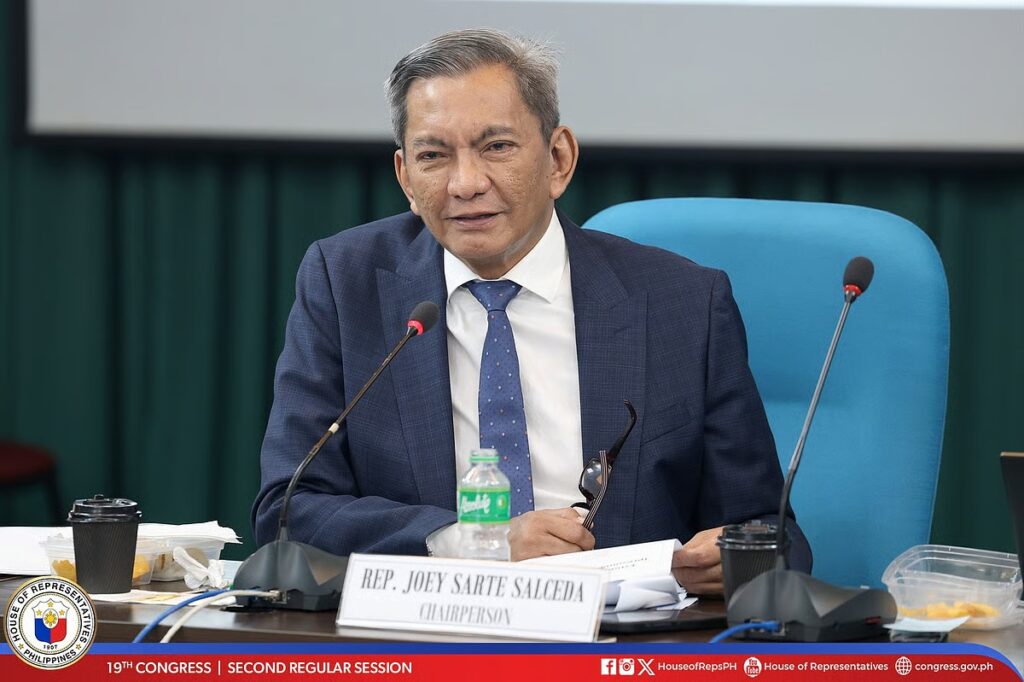
LEGAZPI CITY – Former Albay 2nd District Congressman, Dr. Joey Sarte Salceda, who had also served as first Asian co-chair of the United Nations Green Climate Fund, and now chairs the Institute for Risk and Strategic Studies Inc., has urged Filipinos and their leaders to confront the climate crisis with viable strategies rather than rhetorics. The country “must act not out of illusion but out of necessity, strategy and survival,” he stressed.
Speaking at the National Summit on Climate and Disaster Emergency in the Philippines at the Oriental Hotel in Legazpi City last Friday, Salceda said that while the Philippines is one of the most climate vulnerable countries in the world, its volume of emissions is too negligible to alter global outcomes, and therefore climate action must be guided by what directly benefits Filipino families.
“We are one of the world’s most climate vulnerable countries, but our emissions are too small to shift global outcomes on our own, so our strategies must prioritize what benefits Filipinos directly,” he said, emphasizing that “moral arguments alone will not move the world’s largest emitters and that costly self-funded mitigation should not fall on Filipino households unless such measures produce concrete gains or are supported by climate finance.”
“Moral appeals alone will not change the world’s biggest emitters, and costly self-funded mitigation efforts should not burden Filipino families unless they bring about concrete gains or are backed by climate finance,” he emphasized.
Salceda explained that global emissions are determined by the domestic policies of a few major economies such as China and the United States. “This is not to say that moral appeals hold no leverage value. They do in very well-defined cases, but as a fixed strategy, it does not produce lasting results. Instead of symbolic gestures, the Philippines should take the lead in areas where it can make a real global contribution,” he said.
He identified five strategic fields where the Philippines can build world class capability: typhoon engineering and resilient infrastructure, island energy systems and micro-grids, the blue economy and coastal resilience, disaster response technology and early warning systems, and climate smart food systems for the tropics.
Salceda pointed out that the Philippines’ leadership in global climate institutions has yet to translate into proportional domestic benefits. “We have so far secured only about US$137 million from the United Nations Green Climate Fund, even though Filipinos were largely responsible for securing its initial US$10.4 billion when we met in Oslo and I was its co-chair. This was our starting point. High vulnerability, genuine moral standing, some global influence, and weakness help in transforming global expertise into local benefits,” he added.
Salceda also cited his participation in the High Level Roundtable of Climate Leaders during the Bangkok Climate Action Week last October, where he argued that “the Philippines has already exceeded its commitments through rapid renewable energy development, aggressive policies, and implementation by the Department of Energy using its own resources, and that the burden is on developed countries to concessionally finance the shift away from coal and fossil fuels.”
The two-day summit in Legazpi City, titled ‘Climate and Disaster Emergency in the Philippines Towards Anticipatory and Responsive National and Local Climate Investments,’ was organized by the Department of Environment and Natural Resources, the Climate Change Commission, and the League of Local Climate Change Adaptation and Disaster Risk Reduction.
The summit gathered national and local officials, private sector representatives, civil society groups, and leaders from the academe. Delegates from international organizations such as the Asian Development Bank, the World Bank, the European Union, the German Agency for International Cooperation, the Japan International Cooperation Agency, and the Korean International Cooperating Agency shared insights on global climate financing mechanisms and partnerships.
As former Albay governor for three consecutive terms, Salceda successfully formulated and established viable and effective disaster risks reduction management strategies that were subsequently adopted by the national government and local government units.