By Joey Sarte Salceda
Chairman, Institute for Risk and Strategic Studies, Inc
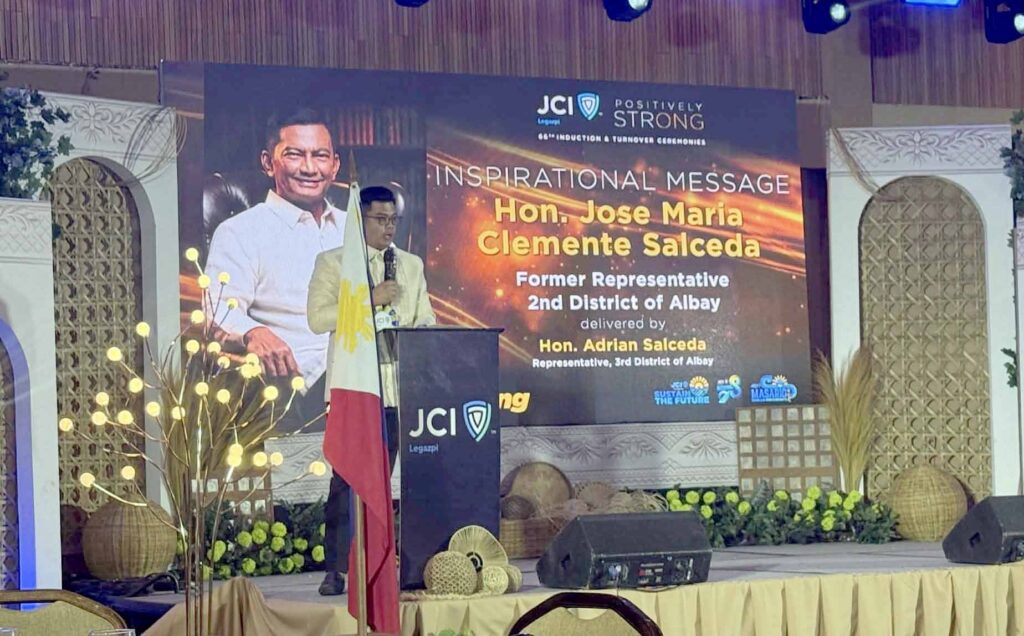
Good evening, fellow Jaycees, officers, inductees, and distinguished guests.
To be invited to speak at a JCI induction is to be asked a very specific question: What does leadership demand of the next generation? I want to answer that question tonight not with a list of virtues, but with something more honest. I want to talk about four things that leadership will cost you. Four forms of courage that the modern world makes extraordinarily difficult, and yet absolutely indispensable.
I. The Courage of Independent Thinking
We live in a tribal world. Not tribal in the anthropological sense, but tribal in the political and social sense. You are expected to belong. You have to be one thing, or you are the other. If you are dilawan, you cannot say anything good about Duterte. If you are DDS, you cannot concede that President Marcos or the Liberal opposition ever had a point.
If you lean left, the other side calls you a communist. If you lean right, they call you a fascist. There is no middle. There is no nuance. There is only the tribe.
Just this past week, Senator Bam Aquino was skewered by members of his own political circle for saying, and I quote loosely, that ideally, former President Duterte should have been tried in Philippine courts. One can disagree with it, sure. But the reaction was not just disagreement. It was excommunication. People formerly from his corner publicly accused him of cozying up to the DDS, of betraying the cause, of being unfit to lead the opposition. For one sentence. For one idea that deviated, even slightly, from the approved articles of faith.
Politics these days rewards what the great Arab historian Ibn Khaldun called asabiyyah, group feeling. If you signal the correct feelings for your group, you can lead them. If you deviate, you are cast out. That is not leadership. That is the lowest form of followership. If you cannot have your own independent thinking, you do not have the right to lead. You can, at best, follow. And you will probably follow the wrong things.
II. The Courage of Ideas
The courage of independent thinking naturally leads to the courage of ideas.
In the 1840’s, a Hungarian doctor named Ignaz Semmelweis was working at the Vienna General Hospital when he made a simple, world-changing observation: women were dying of childbed fever at catastrophic rates in the ward run by doctors, but not in the ward run by midwives. The difference? Doctors were going straight from the autopsy room to the delivery room without washing their hands. Semmelweis instituted a policy of handwashing with chlorinated lime solution. Mortality rates plummeted, from as high as 18 percent to roughly 1 percent.
You would think he would be celebrated. Instead, the medical establishment rejected him. His colleagues were outraged at the suggestion that their own hands were instruments of death. Semmelweis grew increasingly frustrated and erratic. Eventually, he was committed to a mental asylum, where he was beaten by guards and died of an infected wound within two weeks. He was forty-seven years old.
It would take another twenty years for Pasteur and Lister to confirm his ideas through germ theory. Twenty years. An entire generation of mothers who were likely to die in childbirth but could have been saved.
When I was Governor of Albay, I was obsessed with keeping our Maternal Mortality Rate to an absolute minimum. No one who takes the burden of bearing life should have to lose their own. We achieved the Millennium Development Goal on maternal health as early as 2013, two full years ahead of the 2015 target, alongside all the other MDGs. That did not happen by accident. It happened because we took the idea of zero preventable maternal deaths seriously, even when it required resources and attention that others might have directed elsewhere.
The Bicol International Airport still has critics to this day. But it had to be done. The old Legazpi Airport was congested and, more importantly, was situated in an area increasingly exposed to weather-related hazards. The idea was not merely to build a bigger runway. The idea was to move development upward, to a safer area, and to use the airport as an impetus for new growth in a zone less exposed to risks.
An idea will not have friends at the start. But it will surely have enemies, because every idea is antithetical to some other ideas. Every vested interest has a reason to prefer the status quo.
A leader must always have ideas. The only way to shape the future is through ideas. Without them, you are merely managing the present, and poorly at that.
III. The Courage of Initiative
The third courage is the courage to start. To just do something. Consensus takes too much time sometimes. Complete consensus is impossible, always. Pilot something. Convince people to scale it by showing initial results.
We got some criticisms, and more than a little sneering, when we started the Albay Institute for Artificial Intelligence. Why would Polangui do that? Who were our experts? Some people thought it was just a gimmick, a press release dressed up as a program.
Today, we are the country’s first TESDA micro-credential provider in AI. Industry partners with us. We are helping shape national policy on AI use in schools. And every weekend, there are at least two batches of Albayanos that we train for free. Not to produce AI-generated essays or images, which we believe is mostly a waste of time and computing power, but to create real tools. Vibe-coding. Building applications.
Our BarangAI program pairs students from Bicol University Polangui Campus with barangay officials to vibe-code tools and applications that solve actual local governance problems. We are also the first LGU-led AI institution in the country, and I believe in Southeast Asia.
Soon, we will be conducting TESDA trainings with full scholarship allowances on AI for hundreds of Albayanos. We are crafting a CPD training module for teachers on the ethical use of AI and on how to grade student outputs and design homework in the age of AI. We are a leader in grassroots AI now. The bashers have gone quiet as we have scaled.
Do not wait for consensus. Just start.
IV. The Courage of Introspection
The last courage is the one that is perhaps most unfashionable in our time: the courage to consider the possibility that you could be wrong. The courage of introspection.
Introspection is not very popular these days. Because people always attach to an idea a likely motive. If you think or say something I disagree with, you must have an ulterior motive. The lowest possible motive is assigned to every idea one disagrees with. That is the way people argue now.
Consider the China question, which will define much of our foreign policy in the years ahead. If you dare suggest that we should, perhaps, have a more multifaceted relationship with China, then you must be pro-China. A traitor. A sellout.
Alternatively, if you argue that we should nonetheless acquire capabilities that can deter Chinese aggression, other people will accuse you of courting war with a superpower we supposedly cannot defeat. You cannot win either way, because the argument is not really about China. It is about which tribe you belong to.
Introspection is only possible for people who hold sincere but informed beliefs. There is a remark widely attributed to the great economist John Maynard Keynes: “When the facts change, I change my mind. What do you do, sir?”
Introspection is only possible for the genuinely curious, those who maintain an intellectual humility and an openness to learning something new, even from the opposing side.
Closing: The Road to 2028
Let me close with a word about what lies ahead.
2028 will be divisive. We will be at each other’s throats. I am certain of it. The political alignments will shift and fracture and reconstitute in ways none of us can fully predict. Tempers will be high. The tribal instinct will be overwhelming.
As rising leaders in business and in your communities, you will have an extraordinary role in shaping the political conversation. From among your crop will come the Assistant Secretaries, the Undersecretaries, the directors of government agencies, and the senior managers of the Philippine business world. Regardless of who wins the 2028 elections, you are going to do the legwork of actually running this country.
I ask you to carry these four courages with you as you do. The courage of independent thinking, so you are not captive to any tribe. The courage of ideas, so you can shape the future rather than merely inherit it. The courage of initiative, so you do not wait for permission to do what is right. And the courage of introspection, so you remain honest enough to change your mind when the evidence demands it.
These are not easy things. They are costly. They will make you enemies. But they are the difference between a leader and a follower, between someone who shapes events and someone who is shaped by them.
(NOTE: The following feature article is the keynote address by former Albay 2nd District Rep. Joey Sarte Salceda delivered at the induction program of the Junior Chamber International (JCI) in Legazpi City, recently.)