


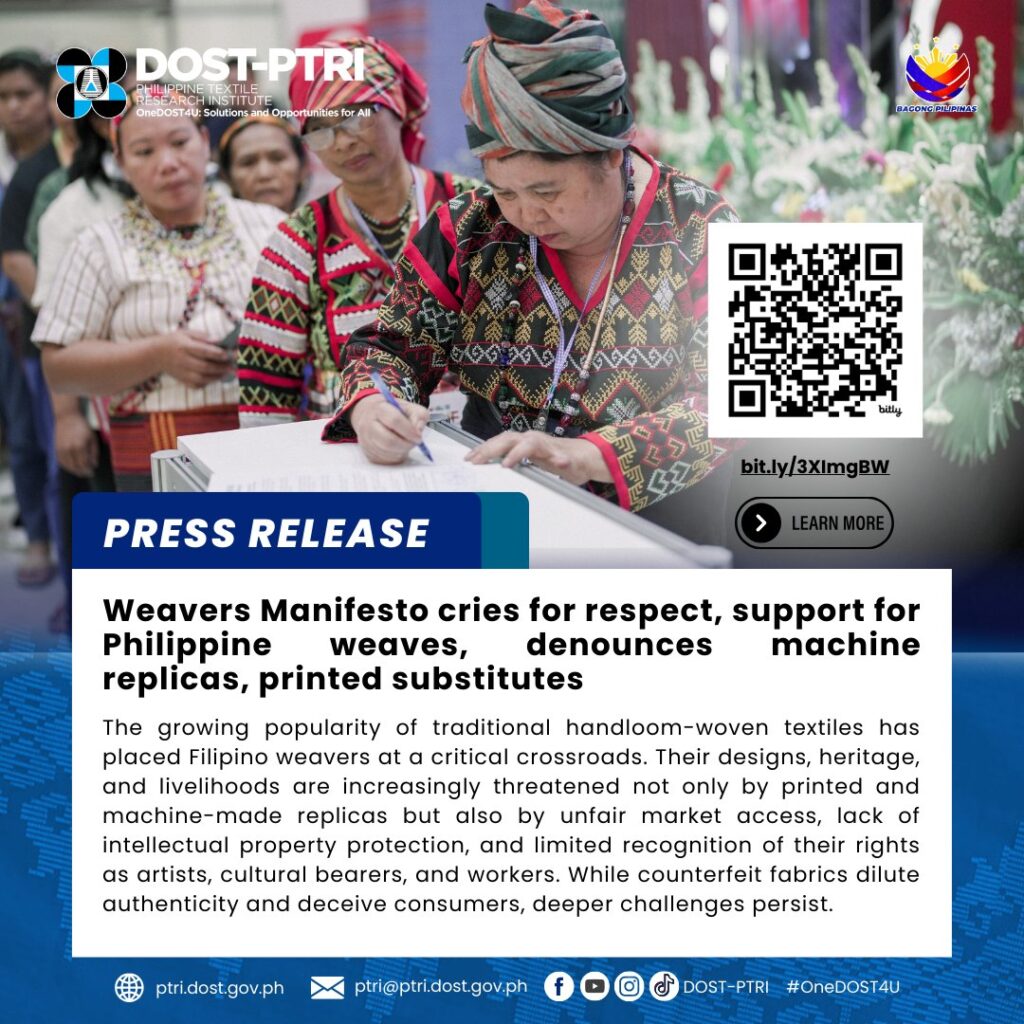
The growing popularity of traditional handloom-woven textiles has placed Filipino weavers at a critical crossroads. Their designs, heritage, and livelihoods are increasingly threatened not only by printed and machine-made replicas but also by unfair market access, lack of intellectual property protection, and limited recognition of their rights as artists, cultural bearers, and workers. While counterfeit fabrics dilute authenticity and deceive consumers, deeper challenges persist. Weavers struggle to reach inclusive markets, secure fair compensation, and pass down their craft to future generations. These shared concerns have prompted weaving communities across the country to unite and assert their rights to livelihood, cultural identity, and a rightful place in the nation’s textile value chain.
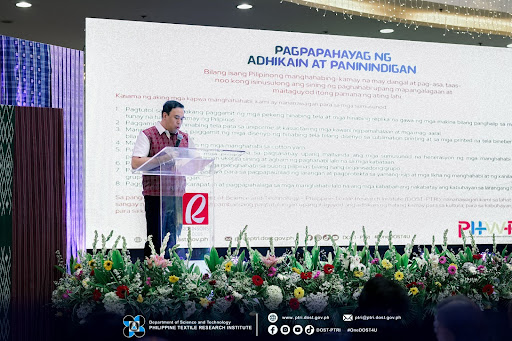
In response to this growing concern, the Department of Science and Technology, Philippine Textile Research Institute (DOST PTRI), consolidated the weavers’ insights and thoughts through the Weavers Manifesto during the 1st Philippine Handloom Weaving Festival held at Robinsons Ilocos in Ilocos Norte on 22 November 2025 as part of the National Science, Technology and Innovation Week. The signing was led by Dr. Julius Leaño Jr., Director of DOST PTRI, and the delegation of more than 120 weavers from over 40 weaving communities across the country. It was witnessed by DOST Ilocos Region Director, Dr. Tereista Tabaog and Assistant Secretary Anna Carmela V. Remigio, Presidential Assistant for Northern Luzon.

The DOST–PTRI and the weavers initially conducted a focused group discussion (FGD) that raised the concerns and needs of weaving communities across the country. The resulting Weavers’ Manifesto captured the 8 main and critical issues raised during the FGD. The signatories call for the following:
- Opposition to the widespread use of counterfeit handwoven textiles and machine-made woven replicas as substitutes for the authentic handwoven fabrics of the Philippines. (Pagtutol sa malawakang paggamit ng mga pekeng hinabing tela at mga hinabing replika na gawa ng mga makina bilang panghalip sa mga tunay na habing-kamay ng Pilipinas.)
- Use of handwoven textiles for the uniforms and attire of government employees and students. (Paggamit sa mga hinabing tela para sa uniporme at kasuotan ng mga kawani ng pamahalaan at mga mag-aaral.)
- Strong opposition to the use of woven textile designs in sublimation printing and in printed fabrics being sold as if they were handloom woven. (Mariing pagtutol sa paggamit ng mga disenyo ng hinabing tela bilang disenyo sa sublimation printing at sa mga printed na tela binebenta bilang hinahabing tela.)
- Expanded access for weavers to cotton and natural textile fiber-based yarns. (Mas pinalawak na akses ng mga manghahabi sa cotton at natural textile fiber-based yarns.)
- Broader access to training programs to prepare the next generations of weavers and to promote knowledge about the art and science of weaving, especially among the youth. (Pinalawak na akses sa mga programa sa pagsasanay upang maihanda ang mga sumusunod na henerasyon ng mga manghahabi at pagpapalaganap ng kaalaman ukol sa sining at agham ng paghahabi lalo na sa mga kabataan.)
- Unification of all weavers across the Philippines into an organized group. (Pagbubuklod ng lahat ng mga manghahabi sa buong pilipinas bilang isang organisadong grupo.)
- Strengthening policies for the development of the weaving sector and for the protection of intellectual property and the creations of weavers and their respective communities. (Pagpapaigting ng mga polisiya para sa pagpapaunlad ng larangan at pagprotekta sa yamang-isip at mga likha ng manghahabi at ng kanilang grupong kinabibilangan.)
- Respect for the rights and recognition of weavers, especially women whose livelihoods depend on this craft. (Paggalang sa mga karapatan at pagpapahalaga sa mga manghahabi lalo na ang mga kababaihang nakabatay ang kabuhayan sa larangang ito.)
As the Weavers’ Manifesto underlines the importance of keeping weaving traditions alive for cultural and economic advancement of weavers, a testimony came from Marlyn Muyana of the Baraclayan Weavers Association of Iloilo who shared how their community’s weaving center contributes to their community advancement, “Before the weaving center was established, our barangay was considered one of the poorest in the municipality. Many families struggled to meet daily needs, and sending children to school felt like an impossible dream. But through hard work, unity, and commitment, the weaving center became our turning point. Today, we are proud to say that we have no out-of-school youth in our community. Almost all our students now have the chance to pursue higher education in colleges and universities.”
The said Manifesto is also in line with the advocacy raised by Dr. Leaño, Jr., during the opening ceremony of the festival, when for the first time he publicly called on the public and said, “Sana po ‘wag na kayong bumili ng fake handloom woven fabrics…because you are not just depriving them of their livelihood. You are depriving them of their culture. You are depriving them of their identity. And most importantly, you are depriving them of their future.”
The Philippine Handloom Weaving Festival generated over ₱2 million in gross sales of handloom woven products from over 120 participating weavers from more than 40 weaving communities representing various regions across the country. A total of 600 kilograms of cotton yarns was also distributed to the weavers as part of the CottonPH Weaving Movement, a program that aims to boost local handloom weaving, reduce dependency on imported yarns, and promote sustainability by providing weavers with locally spun quality yarns. This is the first massive distribution of yarns that awaits feedback on the weavibility and the overall transitioning journey that the weavers will undergo in weaving Philippine cotton yarns. Ilocos Norte will also be able to spin and produce cotton yarns for Northern Luzon after the inauguration of the facility last 20 November in Vintar, Ilocos Norte, during the duration of the Festival.
The four-day festival attracted over 1,000 participants in all its activities. The 1st Philippine Handloom Weaving Festival is a collaboration of the Provincial Government of Ilocos Norte, Ilocos Norte Tourism, Cebu Pacific Air, Robinsons Ilocos, and the Local Government of Taguig City, which is the host city of the Philippine Handloom Weaving Center