


By Joey Sarte Salceda
Chair, Institute for Risk and Strategic Studies, Inc.
First things first. Over the past three days, some quarters have tried to pin on me the PhilHealth excess funds issue. This came from an interview by former Associate Justice Carpio, who claimed I “inserted” the provision and that the final text was “lifted from my bill. These are strong words, and both incorrect.
First, I was never a member of the Appropriations Committee, the small committee, or the bicam in the 19th Congress. An “insertion” by me is procedurally impossible.
Second, the idea that the 2024 provision was “lifted” from my bill simply does not stand. My bill never became law. It sought to amend the 2023 budget and allowed GOCC excess funds to be tapped only if they were unencumbered by benefit obligations. Under that rule, PhilHealth could not remit anything if it hadlegal liabilities to fund.
The 2024 provision was completely different. It mandated GOCCs to reduce their reserves to “historical levels” and imposed deadlines for submission— effectively compelling the release of any free cash on hand. That is why it ran into constitutional issues, especially for GOCCs whose charters protect their reserve funds.
But I am not blind to the political convenience of directing some of the blame toward someone no longer in office like me. It allows current elected and appointed officials to conserve political capital for more pressing work. If this is a moment to take one for the team, I can live with that. We are after all, Team Philippines, as FVR used to say.
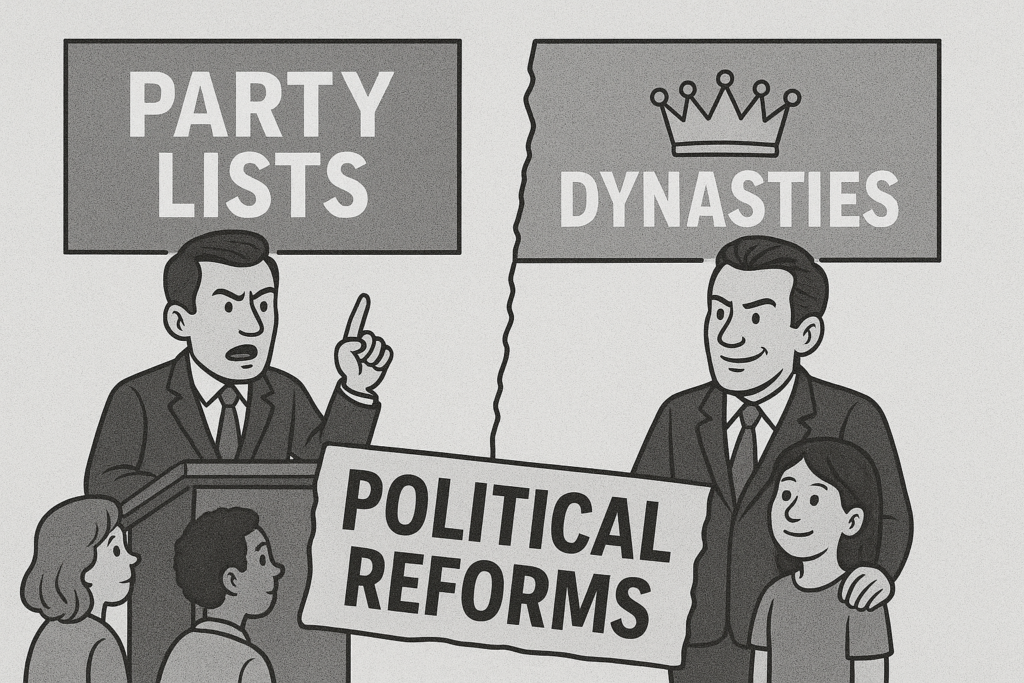
But political capital should be spent on something far more worthwhile. Which is why it is laudable that the President has asked LEDAC to prioritize fundamental political reforms: fixing the Party List system and ending political dynasties.
Political reform
I was a politician for 27 years so I have lived and breathed politics. I know the game.
After twenty-seven years in politics, I have learned that political reform will never succeed unless it confronts the actual motivations of politicians. People outside the system imagine dynasties and party-list manipulation as moral failures. But inside the system, they function as survival mechanisms even for people with the best intentions. If we do not address the survival logic, no amount of legislation will fix the problem.
Political dynasties exist because the structure of our institutions rewards them. Term limits force you out of office just when your projects mature and your networks stabilize. You cannot run again, so you must find someone who can hold the post while preserving the work you built. Parties are too weak to guarantee continuity. Campaigns are too expensive to entrust to a stranger. In that situation, family becomes the only reliable option.
Continuity is the first instinct of any politician. You want your programs finished. You want your constituency cared for. You want your political organization protected from rivals who will dismantle everything you started. In the real world, you do not choose a successor based on abstract democratic theory. You choose someone you trust completely, someone who shares your incentives. That is almost always family.
If you ban dynasties without fixing the underlying conditions, succession does not become more democratic. It simply shifts to the next most reliable source of continuity. In my experience, two groups emerge: staffers and contractors. Staffers are the ones who truly know the work-the chiefs of staff, political officers, administrators who have been solving problems for decades. They have the competence and the institutional memory. Many of them deserve to lead.
But staffers rarely have the financial capacity to run a district-wide campaign. The cost of maintaining a political organization is brutally high. Even a competent staffer will struggle to win without money. If you do not reform campaign finance, staffers and proteges will be outbid or out-organized.
That leaves the second group: contractors and moneyed interests. When families step aside and competent staff lack resources, businessmen with cash and machinery fill the vacuum. I have seen this happen repeatedly. They treat politics like an investment. They expect a return. Their strength comes not from public trust but from capital, and they often govern with that same logic.
This is the danger of banning dynasties in isolation. You weaken the existing network of trust and continuity, but you do not replace it with institutional support.
You simply transfer power to those most capable of financing a campaign. The country does not get better governance. It gets procurement politics.
Real reform must therefore ask a hard question: How does a competent person survive politically without depending on family or contractors? If we cannot answer that, then any dynasty ban is surface-level. Campaign finance reform, career pathways for political staff, and stronger parties are not optional. They are the replacement system.
Party list system
The same survival logic explains why the party-list system has deteriorated. The Constitution imagined a mechanism to uplift marginalized sectors. But the requirement itself created a race to invent the most legally defensible “sector.” After years inside the system, I saw how the definition of “marginalized” became a competitive industry. Any group could qualify as long as you had the lawyers.
The second design flaw was the three-seat cap. Even when the public clearly supported certain advocacies, the system capped their growth. A party-list could win millions of votes (this happens to all colors – whether Makabayan or Akbayan or Duterte Youth or Richard Gomez’s MAD Against Drugs back in the day) and remain stuck at three seats. That structure prevents any advocacy from evolving into a real ideological party. It traps parties in permanent infancy.
The result is predictable: the system pushed out genuine marginalized groups, encouraged well-funded ones to dominate, and prevented ideological movements from scaling. It became exactly the opposite of what the Constitution intended.
The disappearance of a real opposition in the House after PDAF was abolished also illustrates how reforms can unintentionally weaken democracy. PDAF guaranteed that even minority members had basic resources to take care of their constituents. Whether we like it or not, patronage is still part of political survival in most constituencies. When PDAF disappeared, opposition became too costly. Politicians migrated to the majority simply to survive or worked with the executive agencies.
A reformed party-list system can restore programmatic competition without restoring PDAF. Opening it to ideological parties, genuine ideological parties, gives representatives a platform not tied to local patronage. The Rufus Rodriguez’s Centrist Democrats, Bert Gonzales’s PDSP, labor groups, green movements, and social-democratic organizations could all anchor national conversations if allowed to scale based on public support rather than sectoral technicalities.
If party-list seats become truly proportional, politicians gain an alternative path to survival that does not require family succession. Instead of building dynasties, they can build parties. Instead of relying on kinship and patronage, they can rely on ideas and constituencies of belief.
This is the deeper point: dynasties and party-list abuses are not cultural anomalies. They are rational responses to weak institutions. Even the most well- intentioned politicians behave this way because the system gives them very few other viable options. If we want different behavior, we must change the incentives.
Political reform must give politicians a new path for continuity that does not rely on blood, money, or patronage. If we can build a system where sincerely cultivated proteges can rise, where programmatic parties can scale, and where legislators can survive without begging the executive for resources, then dynasties will fade on their own.
The choice before us is not between dynasties and democracy. It is between personal continuity and institutional continuity. We must build institutions strong enough that families no longer need to carry the weight that parties and political systems should bear. Only then will political behavior change in a meaningful way. I wish the President and his government the very best in this effort. He is President of us all.