


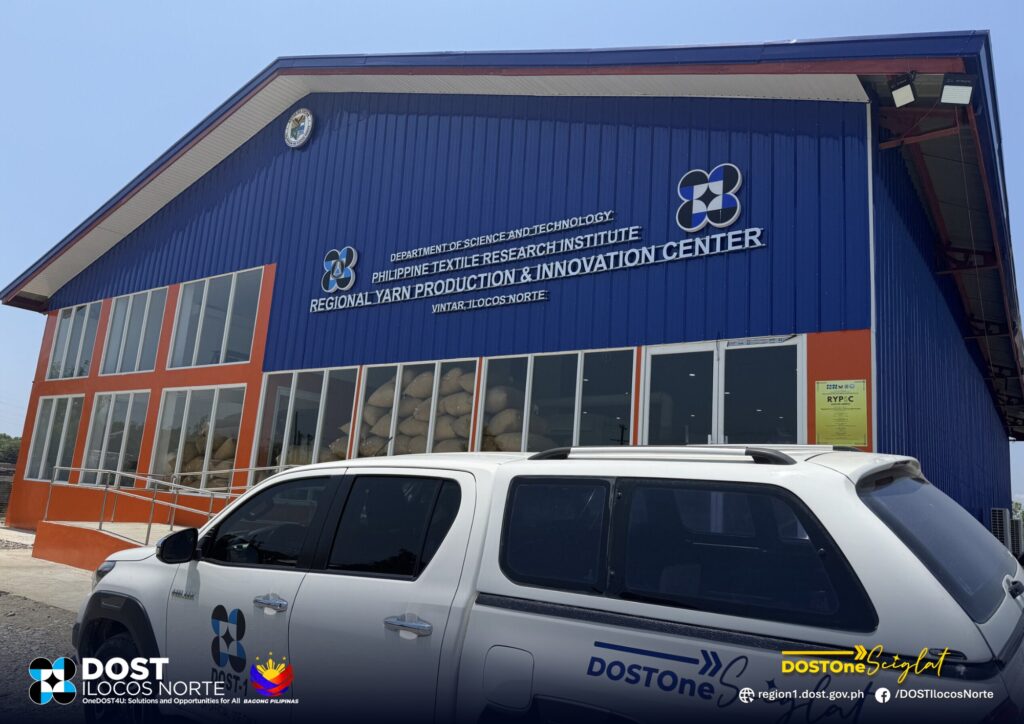
VINTAR, Ilocos Norte — The Department of Science and Technology Ilocos Region (DOST Ilocos Region) successfully partnered with the local government of Vintar to implement a suite of innovation-driven solutions aimed at addressing rising fuel costs and revitalizing local industries.
During the recent consultative meeting, DOST Ilocos Region Regional Director Teresita A. Tabaog and Provincial Director Engr. Brian U. Rasco proposed the integration of e-mobility solutions, including e-tricycles and the establishment of charging stations, to modernize the municipality’s transport sector. To provide immediate economic relief, DOST Ilocos Region also committed to conducting comprehensive energy audits for municipal offices and commercial establishments to identify inefficiencies and optimize electricity consumption.

Beyond energy and transport, the partnership aims to expand Vintar’s textile industry through the Regional Yarn Production and Innovation Center (RYPIC). The initiative seeks to modernize the production of traditional abel fabrics by introducing industrial power looms and diversifying raw materials to include bamboo, abaca, and cotton.
Mayor Richard A. Degala expressed full support for the program, noting that initial steps are already underway in coordination with the Philippine Fiber Industry Development Authority (PhilFIDA) to assist local farmers in scaling up cotton production to meet emerging industrial demands.
In line with strengthening local science, technology, and innovation (STI) governance, Vintar is also among the Local Government Units (LGUs) being eyed by DOST Ilocos Norte for the implementation of the Smart and Sustainable Communities Program (SSCP) and the establishment of a Municipal Science, Technology, and Innovation (STI) Council.
To ensure the sustainability of these initiatives, Director Tabaog emphasized the need for a dedicated focal person to oversee the implementation of high-impact initiatives.
DOST Ilocos Region also pledged to provide specialized monitoring systems to enable the municipality to track fuel and power consumption in real time. This strategic partnership marks Vintar’s transition toward becoming a “smart and sustainable” community—leveraging science and technology to balance modern innovation with the preservation of local resources and heritage. (Kenneth P. Siruet)